
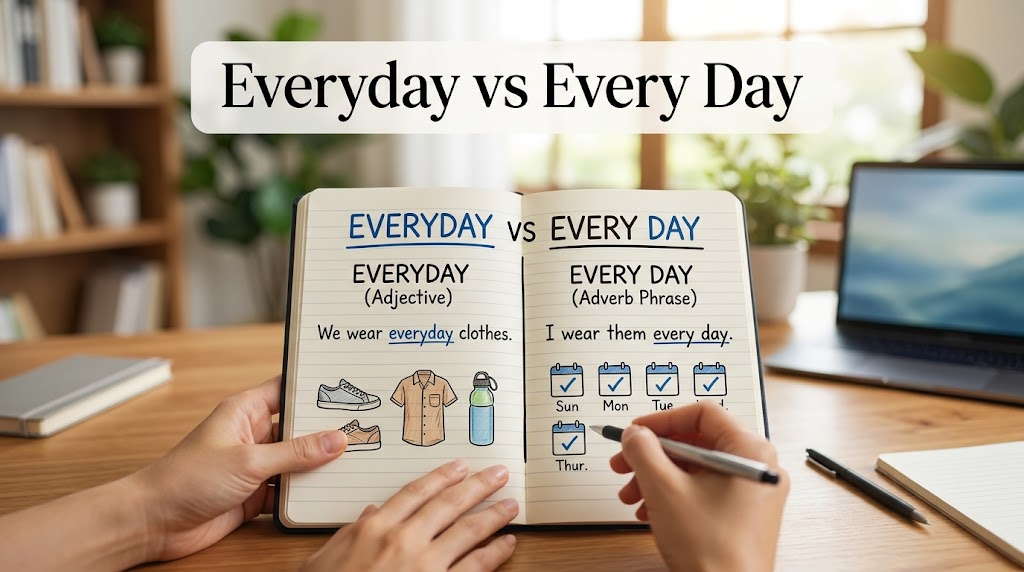

Learning English grammar can sometimes feel like a tricky puzzle with too many missing pieces. One of the most common mix-ups happens when people try to figure out Everyday vs Every Day. At first glance, these two terms look almost identical to the naked eye. You might wonder why a simple space can change the meaning of a whole sentence so much. Writing clearly is important whether you are sending a school email or texting a friend. When you use the right words, people understand your message without any confusion or guessing games. This fun and simple guide will help you master everyday vs every day in no time. We will use easy examples, helpful tricks, and clear explanations designed just for you. By the end of this journey, you will never have to guess which spelling to use again. Let us dive right in and explore these common words together with a big smile!
| Term | Part of Speech | Meaning | Example Sentence |
| Everyday (one word) | Adjective | Ordinary, normal, or used for daily use | These are my everyday shoes. |
| Every day (two words) | Adverbial Phrase | Each day or all the days | I brush my teeth every day. |
What Is the Core Difference Between Them?
To understand everyday vs every day, we need to look at how grammar jobs work. Words have specific roles just like players on a sports team do. When you write everyday as one single word, it acts as an adjective. An adjective is a describing word that tells us more about a noun. On the other hand, when you write every day as two separate words, it is an adverbial phrase. This phrase tells us how often something happens or when an action takes place. Remembering this basic rule makes choosing the correct option much easier for everyone. Think of the single word as describing a thing, like clothes or shoes. Think of the two words as answering the question of how frequently something occurs. Once you practice this idea, your brain will spot the difference instantly without any stress. Let us look closer at the single-word version right now.
Understanding the Single Word Everyday
Let us explore the single word version of everyday vs every day in more detail. When words stick together without a space, they team up to form a brand new meaning. Everyday means normal, routine, ordinary, or suitable for everyday use. For example, your comfortable sneakers might be your favorite everyday shoes for school. You wear them on regular days when you do not need fancy dress clothes. Another good example is your everyday backpack that carries your books and pencils. It is a common item that you use on a regular basis without thinking twice. If something happens on a normal school day, you can describe it using this single word. Writers use this term to show that an object is part of a standard routine. It is a very handy adjective that appears in many books and stories. Now you know how the single word works in real life!
Understanding the Phrase Every Day
Now let us switch gears to the two-word phrase in everyday vs every day. When you put a space between every and day, you create something completely different. Every day is an adverbial phrase that means each day or all the days. If you do an activity from Monday through Sunday, you do it every day. For instance, you might eat breakfast every single morning before heading out the door. The word every modifies the noun day, telling us that no single day is left out. A quick trick is to replace the phrase with each day in your sentence. If the sentence still makes sense, then you know you need the two-word version. This simple substitution method is a secret weapon for writers of all ages. You can test it out on your homework to check your own work. Practicing this rule makes your writing look super professional and neat.
Simple Tricks to Tell Them Apart
Learning grammar rules is much easier when you have fun tricks to help your memory. When you are confused about everyday vs every day, try the replacement test. Look at your sentence and see if you can swap the term with ordinary. If the word ordinary fits nicely, you should use the single-word adjective everyday. If ordinary does not fit, try swapping the spot with each day instead. If each day sounds correct, then the two-word phrase every day is your winner. Another fun trick is to look at the extra space in the two-word version. That extra space stands for the time that passes between each and every day. Visual tricks like this help your brain remember rules without feeling bored or tired. You can even write these tricks down on a colorful sticky note. Put that note on your desk to review whenever you write stories.
Common Mistakes People Make Online
Even adults make mistakes when typing out everyday vs every day in their messages. Many people rush their typing and forget to add that important middle space. Autocorrect can sometimes fix it, but other times it makes funny errors instead. If you write that you drink water everyday, you actually wrote that the water is ordinary. But what you really meant is that you drink water every day of the week! Mixing these up changes your entire message and can confuse your readers quite a bit. Being careful with your spelling shows that you care about good communication skills. Taking just one extra second to check your work prevents silly writing mistakes. Good writers always proofread their paragraphs before sharing them with the world. You can become a master at spotting these tiny errors with a little practice. Let us look at more ways to get better at everyday vs every day today.
Fun Examples of Everyday in Sentences
Seeing words in action helps your brain understand how they work in real life. Let us check out some fun sentences using the adjective form of everyday vs every day. My cat has an everyday routine of sleeping on the warm sunny windowsill. Those old sneakers are my trusty everyday shoes for walking to the park. Writing stories is an everyday hobby that brings me a lot of joy. We should save our fancy plates for parties and use our everyday bowls now. These examples show how the single word describes normal, regular things around us. When an object is used for routine tasks, the single word fits like a glove. You can try making up your own sentences using this fun adjective right now. Sharing your sentences with a friend is a great way to test your skills. Writing practice makes your brain stronger and your sentences much clearer.
Fun Examples of Every Day in Sentences
Now let us look at some cool examples of the two-word phrase in everyday vs every day. I practice playing my guitar every day to get better and faster. The sun rises in the bright sky every day to warm our planet. My little puppy learns a brand new trick every day at school. We drink a fresh glass of orange juice every day for breakfast. Notice how each of these examples talks about something happening on each separate day. You can easily replace these phrases with each day and check the results. The sun rises in the sky each day sounds totally correct and natural. This proves that the two-word phrase is the right choice for these sentences. Keep practicing these examples until you feel super confident in your writing skills. Mastering everyday vs every day is a wonderful goal for any young writer.
Why Grammar Rules Matter So Much
Some kids ask why we even need rules like everyday vs every day at all. Rules help us share our thoughts clearly so everyone understands our exact meaning. Imagine reading a book where every single word was spelled completely wrong. It would be very hard to enjoy the story or learn anything new from it. Good grammar acts like a clean window that lets the bright sunshine pour through. When your writing is clean and clear, your brilliant ideas shine for everyone. People will respect your writing and take your fantastic stories much more seriously. Learning these rules now gives you a superpower for all your future school projects. You will feel proud when your teacher praises your neat and correct spelling skills. Embracing grammar rules can be fun when you look at it like a game. Let us keep exploring more tips about everyday vs every day together.
How to Teach Friends This Grammar Rule
Sharing what you learn is one of the best ways to remember it forever. You can teach your classmates about everyday vs every day during recess games. Make up a fun quiz game and challenge your best friends to find the errors. Ask them if they know the secret trick of using the word ordinary. When they figure it out, they will feel so smart and accomplished too. Teaching others proves that you truly understand the topic inside and out. It also makes learning feel like a fun party rather than a boring chore. You can create colorful flashcards with sentences missing the correct spelling words. Take turns guessing which version belongs in the blank space on the card. Learning together builds strong friendships and helps everyone improve their writing skills at once. Every student can master everyday vs every day with a little team effort!
Fun Ways to Practice Your Skills Daily
Practice makes progress when you want to master everyday vs every day for good. You can keep a special writing journal just for practicing tricky spelling words. Write down three new sentences every morning before you start your school work. Try to use both versions of everyday vs every day in your daily journal entries. Read your sentences out loud to hear how they sound to your ears. Your ears are great tools for catching awkward phrasing or missing spaces. If something sounds weird, pause and check your spelling rules again. You can also play online grammar games that test your knowledge in a playful way. Turning study time into playtime keeps your energy high and your brain sharp. Stay positive even if you make a few small mistakes along the way. Every mistake is just a stepping stone on your path to becoming a writing pro!
Becoming a Confident Writer Every Day
Building writing confidence takes a little bit of time and a lot of heart. When you master tricky pairs like everyday vs every day, you unlock new doors. You will feel proud when writing stories, essays, and messages to your loved ones. No spelling puzzle will ever be too big for your bright and creative mind. Remember to take deep breaths and check your work whenever you feel unsure. Good writing is a journey of continuous learning and joyful discovery every single week. Keep your pencils sharp, your notebooks ready, and your imagination running wild all year. You have all the tools you need to succeed right inside your head. Celebrate your progress and enjoy the wonderful world of English grammar and creative storytelling. Let us finish up with some quick questions and answers about everyday vs every day!
Frequently Asked Questions
What is the easiest way to remember everyday vs every day?
The easiest way to remember everyday vs every day is by using the word replacement trick. If you can swap the word with ordinary, use the single-word adjective everyday. If you can swap it with each day, use the two-word phrase every day. This simple test works every single time and takes only a few seconds. Practicing this trick will help you master everyday vs every day without any stress or confusion.
Is everyday an adjective or an adverb?
The single-word version everyday is always an adjective that describes a noun. For example, you can talk about your everyday clothes or your everyday routine at school. It tells us that something is ordinary, normal, or used on regular occasions. Do not confuse it with the two-word phrase which acts as an adverbial phrase instead. Knowing this grammatical difference makes choosing between everyday vs every day super simple.
Can every day start a sentence?
Yes, the two-word phrase every day can definitely start a sentence when it shows frequency. For example, you can write that every day brings new adventures and exciting learning opportunities. Just make sure you use the two-word version because it answers when or how often something occurs. Starting a sentence with this phrase is a wonderful way to add variety to your writing. Always double-check your spelling when using everyday vs every day at the beginning of sentences.
What happens if I mix up everyday vs every day?
If you mix up everyday vs every day, your readers might get confused by your message. Writing that you practice soccer everyday means your soccer is ordinary, which makes no sense at all. You actually meant that you practice soccer every day of the week! While people will probably still understand what you mean, fixing these small errors makes your writing look professional. Taking a moment to review everyday vs every day builds strong communication habits.
How can kids practice everyday vs every day?
Kids can practice everyday vs every day by writing fun daily journal entries and stories. You can also create colorful flashcards or play interactive spelling games with your classmates. Asking a teacher or parent to check your sentences is another great way to learn. Turning grammar practice into a fun game helps your brain remember rules much faster. Soon, choosing the right spelling for everyday vs every day will feel totally automatic.
Why is there a space in every day?
The space in every day exists because it is a phrase made of two separate words. The word every modifies the noun day to mean each single day without exception. When the words merge into everyday, they form a brand new adjective with a different meaning. Understanding this visual difference makes it much easier to choose the correct term every time. Mastering everyday vs every day is a fantastic achievement for any young writer.
Conclusion
Mastering grammar rules does not have to be a scary or boring experience for anyone. By understanding these simple word differences, you unlock much better writing skills. Remember that the single word is an adjective for ordinary things in life. The two-word phrase tells us how often something happens on each separate day. Use our handy tricks like the ordinary test and the each day swap to check your work. Practice makes progress, so keep writing fun stories and messages every single week. Your dedication to learning will help your brilliant ideas shine brightly for the whole world to see. Thank you for exploring this grammar guide with us today and happy writing.