
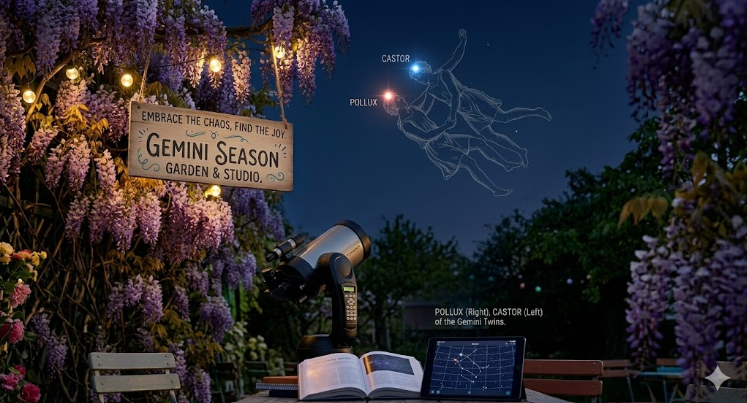

Have you ever looked up at the night sky and wondered about the stories written in the stars? One of the most famous patterns you can find is the Gemini constellation. Known as “The Twins,” this group of stars has been a favorite for star-gazers for thousands of years. It is part of the zodiac, which means the sun passes through it every year. In this guide, we will explore why this star pattern is so special and how you can spot it yourself.
When I first started looking at stars, Gemini was one of the easiest groups to recognize. This is because it has two very bright stars that sit right next to each other. They look like two brothers standing side-by-side in the dark sky. Whether you are a beginner or a pro, finding the Gemini constellation is always a fun challenge. Let’s dive into the details of these celestial twins and see what makes them shine so bright.
Gemini Quick Facts Table
| Feature | Details |
| Common Name | The Twins |
| Brightest Stars | Castor and Pollux |
| Best Seen In | Winter and Spring (Northern Hemisphere) |
| Neighboring Groups | Orion, Taurus, and Cancer |
| Celestial Object | Messier 35 (Star Cluster) |
| Meteor Shower | Geminids (December) |
Where to Find the Gemini Constellation
Finding the Gemini constellation is like going on a cosmic treasure hunt. The best time to look for it is during the winter months if you live in the Northern Hemisphere. During this time, it sits high up in the sky. A great trick is to look for the famous belt of Orion the Hunter first. If you follow a line from Orion upwards, you will run right into the Twins.
The Gemini constellation looks like two long rectangles standing up. At the top of these rectangles are the “heads” of the twins. These are marked by two very bright stars. Once you see those two points of light, the rest of the body is easy to trace. I always tell my friends to look for the “V” shape of Taurus nearby to help stay on track.
The Story of Castor and Pollux
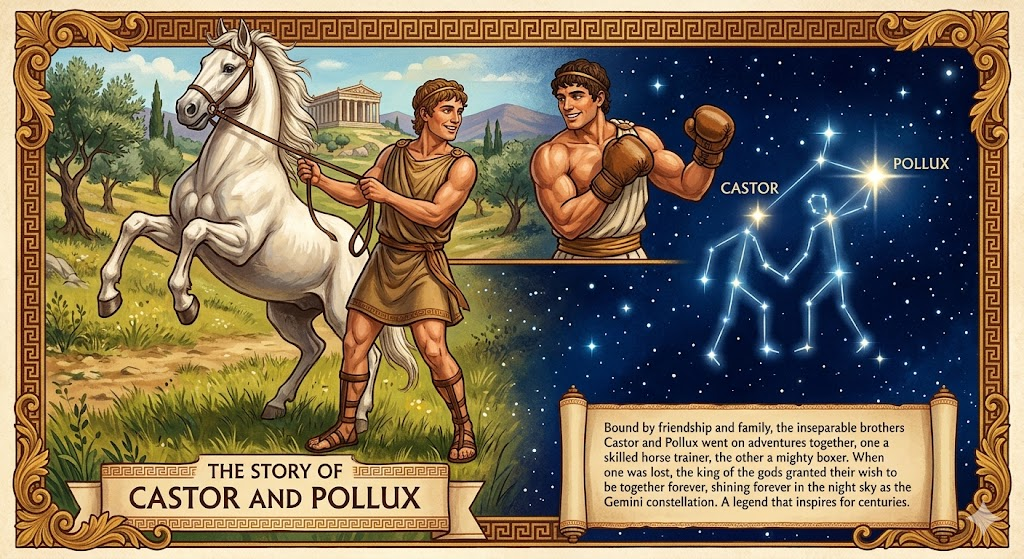
Every star group has a story, and the Gemini constellation is no different. In Greek mythology, these stars represent two brothers named Castor and Pollux. They were very close and went on many adventures together. One brother was a great horse trainer, while the other was a famous boxer. They loved each other so much that they never wanted to be apart.
When one brother was lost, the other asked the king of the gods to keep them together forever. This is why we see them in the sky today as the Gemini constellation. It is a beautiful story about friendship and family. When you look up at them, you aren’t just seeing burning balls of gas. You are seeing a legendary story that people have shared for centuries.
Bright Stars of the Twins
The two most important parts of the Gemini constellation are its brightest stars. Their names are Pollux and Castor. Even though they look like twins, they are actually very different. Pollux is a giant orange star that is closer to Earth. Castor is actually a group of six stars all spinning around each other, which is pretty amazing to think about!
If you look closely at the Gemini constellation, you might notice Pollux is slightly brighter than Castor. Pollux glows with a golden-orange light, while Castor looks more white or blue. In my experience, using a small pair of binoculars can help you see these colors even better. It is fascinating how different stars can be when you take a closer look at them.
The Amazing Geminid Meteor Shower
One of the coolest things about the Gemini constellation happens every December. This is when the Geminid meteor shower takes place. During this time, dozens of “shooting stars” seem to fly out from the area of the Twins. It is one of the most reliable and bright meteor showers of the whole year. You don’t even need a telescope to see it!
I remember sitting outside in the cold last year just to watch the sky near the Gemini constellation. The meteors are often bright and colorful. They move across the sky very fast. If you want to see them, find a dark spot away from city lights. The Gemini constellation puts on a great show every winter, and it is something everyone should see at least once.
Deep Sky Wonders in Gemini
Beyond just the stars, the Gemini constellation hides some deep-sky treasures. One of these is called Messier 35. It is a big cluster of hundreds of stars all grouped together. To the naked eye, it might look like a fuzzy patch of light. But through a telescope, it looks like a pile of sparkling diamonds on black velvet.
Another cool object near the Gemini constellation is the Eskimo Nebula. This is a dying star that has puffed out its outer layers. It looks like a face wearing a fuzzy parka. These objects show us that the Gemini constellation is more than just a simple pattern. It is a window into the deep, mysterious parts of our vast universe.
How the Zodiac Works
You might know that the Gemini constellation is a zodiac sign. This means it sits on a path called the ecliptic. This is the path the sun seems to take across the sky during the year. People born between late May and late June are said to be under the sign of Gemini. In astronomy, this just marks a specific location in space.
The Gemini constellation is the third sign in the zodiac cycle. It comes after Taurus and before Cancer. Long ago, sailors and farmers used the position of the Gemini constellation to know when the seasons were changing. It acted like a giant clock in the sky. Today, we use it to help us map out the stars and learn about our galaxy.
Watching Gemini Through the Seasons
The Gemini constellation isn’t always in the same spot. Because the Earth moves around the sun, the stars we see change. In the winter, Gemini is high overhead at night. By the time spring arrives, it starts to sink lower in the west after sunset. By summer, it is hidden by the bright light of the sun during the day.
If you want to track the Gemini constellation, try looking for it at the same time every month. You will see it slowly shift its position. This is a great way to learn how the Earth moves through space. Seeing the Gemini constellation return to the sky each winter feels like seeing an old friend come back for a visit.
Tips for Better Star Gazing
To see the Gemini constellation clearly, you need to follow a few simple steps. First, try to get away from bright streetlights. The darker the sky, the more stars you will see. Give your eyes about 20 minutes to get used to the dark. You will be surprised at how much more of the Gemini constellation becomes visible once your eyes adjust.
You can also use a star map or a phone app to find the Gemini constellation. Just point your phone at the sky, and it will tell you what you are looking at. I find that starting with the brightest stars, Castor and Pollux, is the best way to begin. Once you find them, the rest of the Gemini constellation will fall right into place for you.
Fun Facts for Kids
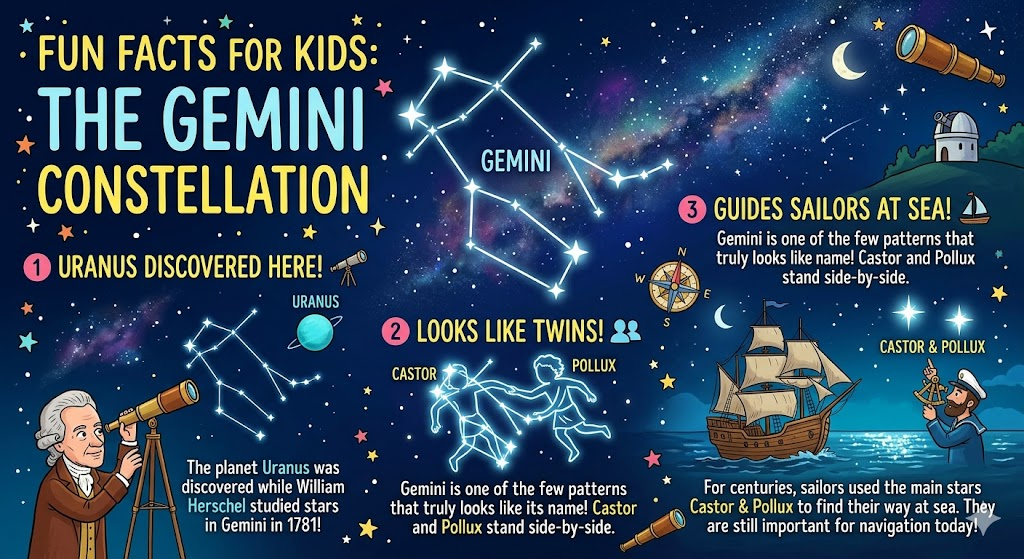
The Gemini constellation has some really weird and fun facts! For example, did you know that the planet Uranus was actually discovered while a scientist was looking at stars in Gemini? It happened back in 1781. Also, the Gemini constellation is one of the few patterns that actually looks like what it is named after.
Another fun fact is that the two main stars in the Gemini constellation are used by sailors to find their way at sea. Even today, these stars are important for navigation. The Gemini constellation is like a permanent map in the sky that never disappears. It is amazing how much one group of stars can teach us about history and science.
Why We Study the Stars
Studying the Gemini constellation helps us understand our place in the world. For thousands of years, humans have looked at these stars to find meaning and direction. By learning about the Gemini constellation, we are connecting with all the people who lived before us. We are all looking at the same beautiful sky.
The Gemini constellation also teaches us about how stars live and die. From the young stars in clusters to the old nebulae, there is a whole life cycle happening right above our heads. Exploring the Gemini constellation is a great way to start your journey into the world of science. Who knows what you might discover when you look up?
Frequently Asked Questions
1. When is the best time to see the Gemini constellation?
The best time is during winter and early spring. In the Northern Hemisphere, it is very high in the sky during January and February evenings.
2. Can I see the Gemini constellation from the city?
Yes! The two main stars, Castor and Pollux, are very bright. You can usually see them even if there are some city lights around.
3. What does the word Gemini mean?
The word “Gemini” is Latin for “twins.” This is why the constellation is often called The Twins.
4. Are Castor and Pollux actual twins?
In stories, yes! In space, they are very different stars at different distances from Earth. They just look close together from where we stand.
5. Is there a planet in the Gemini constellation?
Sometimes! Since Gemini is on the zodiac path, planets like Mars or Jupiter often pass through it.
6. What is the brightest star in Gemini?
Pollux is the brightest star in the constellation. It has a slightly orange glow compared to its neighbor, Castor.
Conclusion
The Gemini constellation is one of the most interesting and easy-to-find patterns in the night sky. From its bright twin stars to its famous meteor shower, there is always something new to see. Whether you are interested in ancient myths or modern science, the Twins have something for everyone. I hope this guide helps you feel more confident the next time you go outside to look at the stars.
Now it is your turn! Tonight, if the sky is clear, go outside and try to find the Gemini constellation. Look for Orion first, then move your eyes up to find Castor and Pollux. Once you find them, you will have a new “sky friend” to look for every year. Happy star-gazing, and don’t forget to share what you find with your friends and family!