
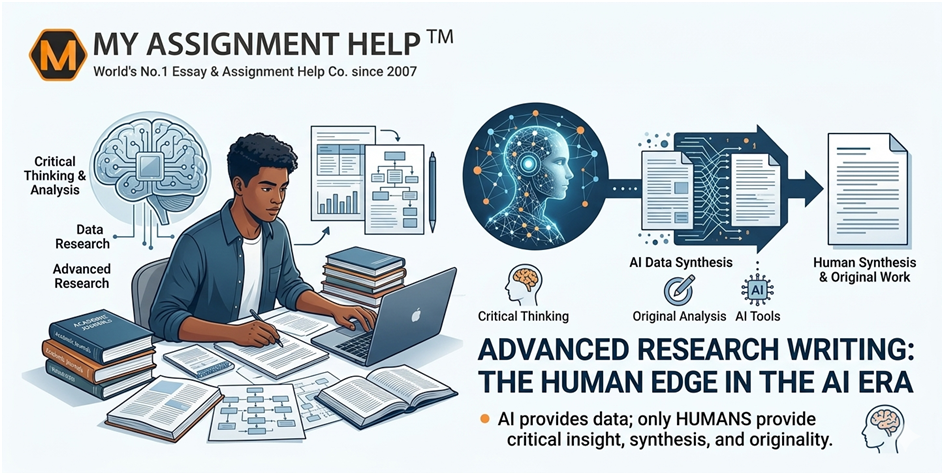

In an era where Large Language Models (LLMs) can generate thousands of words in seconds, a common misconception has surfaced: that the art of writing is becoming obsolete. However, the reality is quite the opposite. As AI-generated content saturates the digital landscape, the value of human-led, advanced research writing has skyrocketed.
While AI is an exceptional tool for synthesis and summarization, it fundamentally lacks the ability to conduct primary research, verify empirical data with 100% accuracy, or provide the nuanced ethical reasoning required in high-level academia and professional thought leadership. Today, advanced research writing is no longer just a “study skill”—it is the ultimate defense against misinformation and the primary driver of innovation.
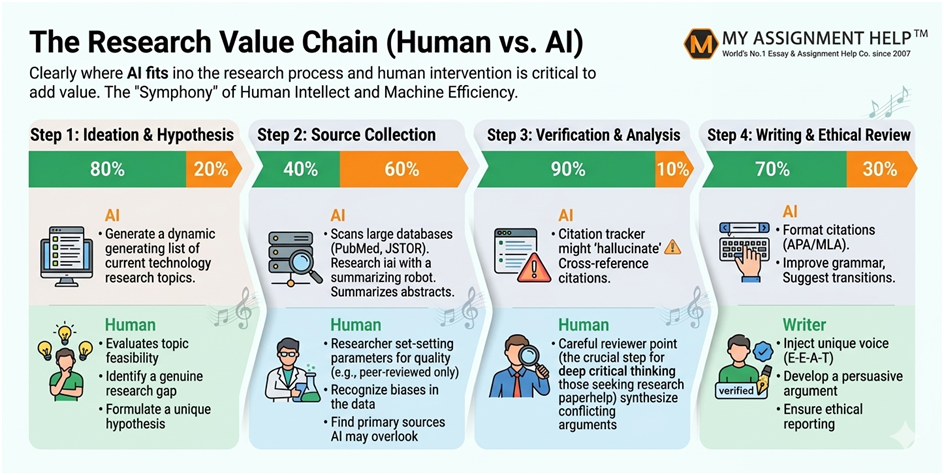
The “Symphony” of Human Intellect and Machine Efficiency
Advanced research writing is a multi-dimensional discipline. It involves critical thinking, the ability to navigate complex databases, the discernment to separate credible sources from “hallucinated” AI data, and the skill to construct a narrative that moves a field forward.
In the current academic climate, students and professionals often feel overwhelmed by the sheer volume of information available. Many turn to research paper help to understand how to bridge the gap between AI-generated drafts and submission-ready, high-impact papers. This human intervention is critical because AI cannot “know” truth; it can only predict the next most likely word in a sequence.
Why AI Cannot Replace Advanced Research
To understand why this skill is more critical than ever, we must look at the structural limitations of artificial intelligence compared to the rigorous standards of Evidence-Based Writing (EBW).
1. The Hallucination Handicap
AI models are known to “hallucinate” or invent citations, dates, and even historical events. In advanced research writing, a single incorrect citation can invalidate an entire thesis. Human researchers provide the “Ground Truth”—the verification process that ensures every data point is rooted in reality.
2. E-E-A-T: The Gold Standard
Google’s Search Quality Rater Guidelines emphasize Experience, Expertise, Authoritativeness, and Trustworthiness (E-E-A-T). AI has no “experience.” It has never conducted a lab experiment, interviewed a subject, or felt the weight of ethical responsibility. Advanced research writing allows authors to inject personal expertise and unique perspectives that AI simply cannot replicate.
3. Navigating Complex Ethics
Researching sensitive topics—be it in bioethics, law, or sociology—requires a moral compass. AI operates on patterns, not ethics. A skilled researcher understands the socio-political implications of their findings, ensuring the work is responsible and biased-informed.
Strategies for Mastering Research in the 2020s
To stay relevant, writers must evolve. This means moving beyond simple “search and find” methods and adopting a “curator” mindset.
- Primary Source Prioritization: Always lean toward peer-reviewed journals, government white papers, and first-hand interviews.
- Synthesizing Contradictions: AI struggles when two sources disagree. A human researcher excels at analyzing why they disagree and providing a reasoned conclusion.
- Technological Literacy: Knowing which technology research topics are currently disrupting the market is essential for staying ahead of the curve. Integrating AI tools for brainstorming while maintaining manual control over the actual writing is the “Cyborg Method” of modern productivity.
The Data: The Growing Value of Critical Writing Skills
According to a 2025 report on the future of work, “Analytical thinking and complex problem-solving” remain the most sought-after skills in the labor market. Furthermore, data from the Chronicle of Higher Education suggests that while 60% of students use AI for initial drafts, those who manually edit and perform independent research score 25% higher on “Critical Analysis” metrics in faculty evaluations.
Research writing is the engine of the knowledge economy. Whether you are drafting a policy brief, a clinical trial report, or a doctoral dissertation, the ability to synthesize data into a coherent, persuasive argument is a superpower.
Key Takeaways
- AI is a Tool, Not an Author: AI excels at formatting and summarizing but fails at primary investigation and factual verification.
- Verification is Key: Advanced research writing acts as a filter for AI hallucinations and misinformation.
- E-E-A-T Matters: Professional and academic success depends on demonstrating genuine expertise and lived experience.
- High Demand: As “cheap” content becomes common, high-quality, data-driven research becomes a premium asset.
Frequently Asked Questions (FAQ)
Q1: Can I use AI to write my entire research paper?
No. While AI can help with outlining or clarifying a sentence, using it to write a whole paper leads to issues with plagiarism, lack of original thought, and potential factual errors that can lead to academic or professional penalties.
Q2: How do I verify if a source is credible?
Look for the CRAAP test criteria: Currency (timeliness), Relevance (importance for your needs), Authority (source of the information), Accuracy (reliability and truthfulness), and Purpose (reason the information exists).
Q3: Why is human writing still preferred by Google and Universities?
Both institutions value original contribution to knowledge. Human writing offers unique insights, emotional intelligence, and accountability that AI cannot provide.
Q4: Is research writing only for academics?
Absolutely not. Content strategists, lawyers, doctors, and business analysts all rely on advanced research writing to make informed decisions and persuade stakeholders.
About the Author: Sarah Jenkins
Senior Academic Consultant at MyAssignmentHelp Sarah Jenkins is a senior content strategist with over 12 years of experience in higher education and technical writing. Holding a Master’s in Comparative Literature, Sarah specializes in helping students navigate the complexities of information architecture and SEO-driven academic writing. She is a firm advocate for the ethical use of EdTech and spends her time researching the intersection of AI and cognitive load in learning.
References:
- Smith, J. (2025). The Digital Information Gap: Why Human Verification Matters. Journal of Media Literacy.
- Bureau of Labor Statistics. (2026). Occupational Outlook for Technical Writers and Analysts.
- Stanford University. (2024). AI and the Future of Academic Integrity.